If a Team Decided to Kick a Fg on 1st Down Can They Go for It Again

Kicker Connor Barth attempting a field goal during an NFL game in 2015
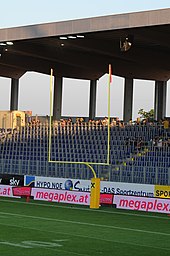
A set of gridiron football goal posts—two uprights (vertical) and a batten (horizontal)
A field goal (FG) is a means of scoring in gridiron football. To score a field goal, the squad in possession of the brawl must place kick, or drop kick, the ball through the goal, i.due east., between the uprights and over the crossbar.[1] American football game requires that a field goal must just come during a play from scrimmage (except in the example of a fair grab kick) while Canadian football retains open field kicks and thus field goals may be scored at whatever fourth dimension from anywhere on the field and by any histrion. The vast majority of field goals, in both codes, are place kicked. Drop kicked field goals were common in the early days of gridiron football but are about never washed in modern times. In well-nigh leagues, a successful field goal awards three points (a notable exception is in six-man football where, due to the difficulty of making a successful field goal because of the modest number of players bachelor to terminate the opposing team from attempting a block, a field goal is worth four points).
A field goal may likewise be scored through a off-white take hold of kicking, merely this is extremely rare. Since a field goal is worth only three points, equally opposed to a touchdown, which is worth vi points, it is usually simply attempted in specific situations (come across Strategy).
The goal structure consists of a horizontal batten suspended ten feet (iii.0 m) above the ground, with ii vertical goalposts xviii feet 6 inches (5.64 k) apart extending vertically from each cease of the crossbar.[2] In American football, the goals are centered on each end line; in Canadian football, they are centered on each goal line.
Strategy [edit]
As a field goal is worth just three points, while a touchdown scores at to the lowest degree six (which usually becomes vii with a successful conversion, and potentially eight with a 2-signal conversion), teams will generally attempt a field goal only in the following situations:
- Information technology is last down (third in Canadian football, fourth downward in American football game), especially if the offense is more than a yard or two from a new first down, and within kicking range of the goal posts (about 45 yards at the professional person level).
- In the first half, if there is only enough time remaining to execute merely one more play, regardless of the downwards.
- In the waning moments of the second one-half, if a successful kick will win or tie the game. In this situation, a team may choose to endeavour the field goal on an before downwards or if in that location is still plenty time remaining to execute more than than one play. If there are problems with the snap or hold, the team would exist then able to abort the kick attempt (kneel downwards, or throw an incomplete laissez passer), and even so have at least one downward and time remaining to re-attempt the kick.
- In overtime, if a successful field goal volition win and end the game, a team may choose to endeavour a game-winning kick equally before long equally they go into field goal range (for example, a long pass completion that advances the brawl within the opponent's 20-yard line). In this situation, a squad may just decide to try to end the game rather than risk another play that could result in an interception or bollix.
Except in desperate situations, a team will generally endeavour field goals but when keeping a drive alive is unlikely, and its kicker has a significant adventure of success, every bit a missed field goal results in a turnover at the spot of the kicking (in the NFL) or at the line of scrimmage (in the NCAA). In American high school rules and Canadian football game, where a missed field goal is treated the same as a punt, most teams nevertheless opt not to attempt field goals from very long range since field goal formations are non conducive to covering boot returns. Fifty-fifty under platonic conditions, the best professional person kickers historically had difficulty making kicks longer than fifty yards consistently.[iii] If a team chooses not to attempt a field goal on their last downward, they can punt to the other team. A punt cannot score any points in American football unless the receiving team touches the brawl first and the kicking team recovers it (though information technology tin can result in a unmarried in Canadian football), but it may push the other team back toward its own cease.
The longest field goal kick in NFL history is 66 yards, a tape set by Justin Tucker on September 26, 2021, which broke the record previously held by Matt Prater (2013) at 64 yards. The 3rd longest is 63, originally set by Tom Dempsey (1970) then matched by Jason Elam (1998), Sebastian Janikowski (2011), David Akers (2012), Graham Gano (2018), and Brett Maher (2019).[4] The tape in the CFL is 62 yards, set up by Paul McCallum on October 27, 2001.[v] High school, college and most professional football leagues offer only a three-point field goal; however, some professional leagues have encouraged more rare kicks through four-point field goals. NFL Europe encouraged long field goals of 50 yards or more by making those worth 4 points instead of three (much like Australian rules' Super Goal or basketball game'due south three-point line), a rule since adopted by the Stars Football League. Similarly, the sport of arena football game sought (unsuccessfully) to repopularize the drop kicking by making that worth four points; information technology failed, since only ane kicker (Brian Mitchell) was able to exercise it with any semblance of proficiency. (In six-human football, all field goals are worth four points instead of the usual three.) The overall field goal percentage during the 2010 NFL season was 82.three%. In comparison, January Stenerud, one of but 3 pure kickers in the Pro Football game Hall of Fame (along with fellow placekicker Morten Andersen and punter Ray Guy), had a career field goal per centum of 66.8% from 1967 to 1985.[3]
How field goals are kicked [edit]
Video of a successful field goal effort.
When a team decides to try a field goal, information technology volition generally line up in a very tight formation, with all but 2 players lined up forth or about the line of scrimmage: the placekicker and the holder. The holder is usually the squad's punter or backup quarterback.[ commendation needed ] Instead of the regular centre, a team may accept a dedicated long snapper trained especially to snap the ball on placekick attempts and punts.
The holder usually lines up seven to eight yards behind the line of scrimmage, with the kicker a few yards behind him. Upon receiving the snap, the holder holds the ball against the basis vertically, with the stitches away from the kicker. The kicker begins his approach during the snap, so the snapper and holder accept little margin for mistake. A split-second error tin can disrupt the entire try. Depending on the level of play, the ball, upon reaching the holder, is held up by either the assistance of a modest safety "tee" (all ranks up to the high school level, which is not the same equally the kickoff tee, but rather a small platform, and comes in either ane or 2 inch varieties) or is held upwards by the ground (in higher and at the professional person level).

The measurement of a field goal's distance is from the goalpost to the indicate where the brawl was positioned for the kick by the holder. In American football, where the goalpost is located at the dorsum of the cease zone (above the end line), the ten yards of the end zone are added to the yard line distance at the spot of the hold.
Until the 1960s, placekickers approached the brawl straight on, with the toe making first contact with the ball. The technique of kicking the ball "soccer-style", by budgeted the ball at an angle and kicking it with the instep, was introduced by Hungarian-born kicker Pete Gogolak in the 1960s.[6] Reflecting his roots in European soccer, Gogolak observed that kicking the brawl at an angle could cover more altitude than kicking direct-on; he played college football at Cornell and made his pro debut in 1964 with the Buffalo Bills of the AFL; his younger brother Charlie was as well an NFL kicker. The soccer-style kicking gained popularity and was nearly universal past the late 1970s; the terminal straight-on kicker in the NFL was Mark Moseley, who retired in 1986.
Successful field goals [edit]
If there is whatsoever time left in the half, the method of resuming play later a successful field goal varies between leagues.
- National Football League and virtually professional leagues
- The scored-against team receives a kickoff.[7]
- National Collegiate Athletic Association
- The scored-against team receives a kickoff.[8]
- National Federation of High Schools
- The scored-confronting squad can choose to either receive a beginning or kick off themselves. (In exercise, almost all choose to receive.)
- Canadian Football League
- The scored-against squad may elect to either boot off, receive a kickoff, or scrimmage from their own 35-chiliad line. In the terminal iii minutes of the fourth quarter, the scoring squad kicks off from their 35-yard line. The choice of scrimmaging from the 35-yard line, first instituted in 1975, was eliminated in 2009, but the change proved unpopular and was reinstated the following season.
- Football game Canada
- The scored-against team may elect to either kick off, receive a get-go, or scrimmage from their own 35-yard line. If they cull to receive, the scoring team kicks off from their ain 45-yard line.[9]
Missed field goals [edit]
A missed field goal is said to be "no good" if the kicked brawl does non cross between the uprights and over the crossbar of the goal posts. If it misses to the side of the uprights, information technology may be called "broad left" or "wide right" as the case may exist. A field goal try may be described as "curt" if it does not have sufficient altitude to go over the cross bar. Some commentators will merely describe a field goal try as being short if information technology appears to accept been aimed correctly while others volition describe an effort actualization to lack both accuracy and distance as being both wide and short.
If a field goal try is missed and does not go out of bounds, a defensive thespian may catch the brawl and return it, like a punt or kickoff. Or a defensive actor may selection upward the ball on the bounciness or while rolling before it stops rolling and is declared dead by a referee. This blazon of play ordinarily occurs during an extremely long field goal endeavour due to the distance the defense must travel to accomplish the returner. If at that place is a significant likelihood of a miss and the strategic game state of affairs warrants it, the defense places a player downfield, in or near their end zone, to catch the ball. The risk in this is that the render man may be tackled deep in his own territory, at a considerably worse position than he could have gotten past letting the ball go expressionless (see below); furthermore, should the returner fumble the brawl, the kicking team tin recover it and proceeds a new prepare of downs (the advantage is that the kicking team is lined upwardly very close together to stop kick blockers, and not spread across the field like a kickoff or punt team, and is therefore in poor position to defend the render). Thus, teams will usually render a kick only towards the terminate of a half (when the kick will be the last play) or in a particularly desperate situation.
If a brawl caroms off ane of the goal posts or the batten but lands in the field of play, the ball is considered dead and cannot be returned. (This is not the case in arena football, where large "rebound nets" environs the goal posts for the explicit purpose of keeping the ball in play.) However, if the ball continues into the goal after caroming, the score counts.
Situations where the defense does non return a missed field goal vary between leagues and levels of play:
- National Football League
- Missed field goals attempted from the defending squad's twenty-yard line or closer outcome in the defence taking possession at their 20-k line. Missed field goals attempted from backside the 20-yard line result in the opposing team taking possession at the spot of the kick. (From 1974-1993, the opposing team would take possession at the line of scrimmage, unless the boot was attempted from inside the xx-yard line, in which case the opposing squad would take possession at the 20-yard line. Prior to 1974, a missed field goal was treated the aforementioned as a punt, and the kicking squad could downward the ball in the field of play if information technology did not cross the goal line; if the unsuccessful attempt crossed the goal line, it was a touchback, unless the defense ran the ball out of the end zone, which did not get legal until 1971.)
- NCAA
- The opposing team takes possession at the line of scrimmage rather than at the spot of the kick. If the line of scrimmage is within the 20-yard line, the opposing squad takes possession at the twenty.[ citation needed ]
- Loftier school
- Under NFHS (high school) rules (except Texas, which plays largely past NCAA rules), a field goal try is no different from any other scrimmage kick (punt, drop kick). If the field goal effort is no good and enters the terminate zone it is a touchback (NFHS rules do not allow a scrimmage boot or free boot to be advanced if it crosses the goal line). If the brawl becomes expressionless on the field the defensive team volition next put the ball in play from that betoken. If a field goal is blocked behind the line of scrimmage either team may choice it up and return it (run across beneath).
- Canadian football
- If the defense does not return a missed field goal out of the terminate zone, or if a missed field goal try goes out the back of stop zone, so the kicking team scores a single point. This sometimes results in the team on defense force stationing their punter backside the goal posts to punt the brawl out of the end zone, in case of a missed field-goal attempt, to preserve a victory or tie. Also, a missed field goal may be played past any onside player on the kicking squad (onside players being the kicker and anyone behind him at the time of the kicking). Information technology is risky to have anyone positioned behind the kicker when the brawl is being kicked since those players would be unable to help preclude the defending players from blocking the kick; however, on occasion teams might intentionally miss a field goal in hope of recovering the ball in the end zone for a touchdown. Returning a missed field goal is much more than probable in Canadian football game than in American rules for a few reasons. Commencement, since the goal posts are on the goal line in front of a twenty-one thousand finish zone (rather than at the back of a x-chiliad terminate zone), a missed field goal is much less likely to get out of bounds while in the air. As well, non returning the ball out of the end zone results in the defence conceding a single bespeak, which may be crucial in a close game. Moreover, the wider field of the Canadian game makes the average return longer (in terms of yardage). Yet, many Canadian football coaches judge that conceding a unmarried and taking possession at the 35-yard line is preferable to returning a missed field goal and fugitive a single at the cost of poor field position.
Blocked field goals [edit]


Occasionally, the defense will succeed in blocking a field goal. If the brawl falls in or behind the neutral zone, it is treated like a bollix and can exist avant-garde by either team. If the ball instead falls forward beyond the neutral zone, it is treated like a missed field goal under the rules explained in a higher place.
History [edit]
In the early on days of football, kicking was emphasized. In 1883, the scoring arrangement was devised with field goals counting for five points, and touchdowns and conversions worth iv points. In 1897, the touchdown was raised to five points while the conversion was lowered to one point. (In 1958, the NCAA created the two-bespeak conversion for conversions scored via run or pass; the NFL followed suit in 1994.) Field goals were devalued to four points in 1904, and then to the modern 3 points in 1909. The touchdown was changed to six points in 1912 in American football; the Canadian game followed suit in 1956.
The spot of the conversion has also changed through the years. In 1924, NCAA rules spotted the conversion at the 3-yard line, before moving it back to the 5-thousand line in 1925. In 1929, the spot was moved up to the 2-yard line, matching the NFL. In 1968, the NCAA diverged from the NFL rules and moved the spot back to the original 3-grand line. Canadian rules originally spotted the conversion at the 5-one thousand line, which remains closer than in the American code (for kicked conversions) as the goalposts are at the front of the stop zone.
In 2015, to make conversion kicks harder, the NFL and CFL moved the line of scrimmage for conversion kicks to the xv- and 25-g lines, respectively. (The CFL likewise moved the spot for two-point conversion attempts to the 3-thou line, while then NFL remained at the two-yard line.)
The goalposts were originally located on the goal line; this led to many injuries and sometimes interfered with play. The NCAA moved the goal posts to the rear of the end zone in 1927. The NFL (even so following NCAA rules at the time) followed suit, but moved the posts dorsum to the goal line starting in the 1932 NFL Playoff Game, a alter made necessary by the size of the indoor Chicago Stadium and kept when the NFL rules stopped mirroring the NCAA rules in 1933. The NFL kept the goal posts at the goal line until 1974, when they were moved back to the rear of the cease zone, where they accept remained since. This was partly a upshot of the narrowed hashmark distance fabricated in 1972, which had made for easier field-goal angles. The Canadian game however has posts on the goal line.
The width of the goalposts and the hashmarks have also varied throughout the years. In 1959, the NCAA goalposts were widened to 23 anxiety 4 inches (7.11 m), the standard width for high schoolhouse posts today. In 1991, the college goalposts were reduced in width to 18 ft 6 in (5.64 m), matching the NFL. For the 1991 and 1992 seasons, this meant potentially severe angles for short field goal attempts, since the hashmark width remained at 53 ft 4 in (16.26 m). In 1993, the NCAA narrowed the distance between the hashmarks to xl ft (12.19 m), matching what was the width of hashmarks in the NFL from 1945 through 1971; the NFL narrowed the hashmarks in 1972 to goalpost width at eighteen.five feet (5.64 one thousand). In the CFL, the hashmarks are 51 anxiety (16 one thousand), but the field is 195 feet (59 m) in width, 35 feet (11 m) wider than the American field.
The NFL increased the top of the uprights to a higher place the crossbar to twenty feet (half dozen.10 m) in 1966 and thirty feet (nine.xiv chiliad) in 1974. In 2014, they were raised 5 anxiety to 35 feet (ten.67 g) after the adoption of a proposal by New England Patriots head bus Bill Belichick.[ten]
The "slingshot" goalpost, having a unmarried postal service curving 90° up from the footing to support the batten, was invented past Jim Trimble and Joel Rottman in Montreal, Quebec, Canada.[11] The first ones were built by Alcan and displayed at the Expo 67[11] [12] world's off-white in Montreal. The NFL had standardized its goalposts in 1966 and adopted the slingshot for the 1967 season.[11] The NCAA subsequently adopted the same dominion, merely later allowed the use of "offset" goalposts with the older two-mail base of operations. The CFL was the outset league to use the slingshot goalposts. They debuted in the 2d game of the CFL's Eastern Conference final in 1966 at Montreal's Autostade considering Landsdowne Park (now TD Identify Stadium), the home of Ottawa Crude Riders, was undergoing renovations. They were too used in the Grey Cup the next week at Vancouver's Empire Stadium. Three schools in Division I FBS currently utilise dual-support posts: Florida State, LSU, and Washington State. A special exemption was allowed by the NFL for the New Orleans Saints to utilize the beginning goalposts during the 2005 season, when they used LSU's stadium for dwelling games after Hurricane Katrina.
Goalposts at the professional person level today are sometimes equipped with a video camera mounted to the stanchion immediately behind the center of the crossbar. Since these cameras are both higher up and slightly backside the crossbar, a field goal attempt will be judged good if information technology strikes this equipment.
A small-scale, plastic "tee", which can exist 1 or two in [25 or 51 mm] loftier (smaller than the kickoff tee) may be used for field goals and extra points in the lower ranks of football game up through high school. Unlike in the lower ranks of play up to the high school level, the NFL (and most other professional leagues) has never immune the use of "tees" for field goal kick attempts, having ever required kickers to kick off the ground for such attempts (and for extra points; a rare exception for a U.S.-based pro league to allow the usage of such tees for such attempts was the USFL in the 1980s).[13] [14] In 1948, the NCAA authorized the employ of a small rubberized kicking tee for field goals and extra points, but banned them by 1989, requiring kicks from the basis like the NFL.[fifteen] [sixteen] The Canadian Football League, despite its status as a professional person league, does allow the use of a tee for field goals and convert kicks, but it is optional. Kickers tin can choose to kick off the ground if they want.[17]
During the 2011 NFL season, a record 90 field goals of fifty yards or longer were made.[xviii] In 2012, this tape was raised to 92 field goals of l yards or longer.[xviii]
Longest field goal records [edit]
According to the Guinness Earth Records, the longest recorded field goal successfully kicked at whatever level was 69 yards. It was kicked by Ove Johansson of the Abilene Christian Academy Wildcats in the 1976 game confronting East Texas State University Lions (at present Texas A&M University–Commerce) in Shotwell Stadium, Abilene, Texas.
NFL [edit]
The longest successful field goal in NFL history was 66 yards by Justin Tucker of the Baltimore Ravens confronting the Detroit Lions on September 26, 2021.[xix] The longest field goal attempt in an NFL game was 76 yards by Sebastian Janikowski of the Oakland Raiders against the San Diego Chargers on September 28, 2008.[20]
| Altitude | Kicker | Team | Result | Opponent | Date | Notes | Location | Elevation | Weather condition |
|---|---|---|---|---|---|---|---|---|---|
| 66 yards | Justin Tucker | Baltimore Ravens | 19–17 | Detroit Lions | September 26, 2021 | Correct-footed; game-winning field goal every bit time expired; ball bounced off crossbar before crossing the plane.[19] | Ford Field | 601 ft (183 one thousand)[21] | Dome |
| 64 yards | Matt Prater | Denver Broncos | 51–28 | Tennessee Titans | December viii, 2013 | End of 1st one-half[22] | Sports Authorization Field at Mile High | 5,200 ft (1,585 m) | thirteen °F (−11 °C); Sunny; Wind: S at three mph; Humidity: 72% |
| 63 yards | Tom Dempsey | New Orleans Saints | 19–17 | Detroit Lions | November eight, 1970 | Built-in with a stub for a right foot. Game-winning kick as time expired. Detroit kicker Errol Isle of mann had kicked a field goal with 0:11 remaining to give Lions the pb. Previous record was 56 yards in 1953.[23] | Tulane Stadium | 16 ft (5 m) | 65 degrees, relative humidity 79%, wind 10 mph |
| 63 yards | Jason Elam | Denver Broncos | 37–24 | Jacksonville Jaguars | October 25, 1998 | First field goal to tie tape | Mile High Stadium | 5,200 ft (one,585 m) | |
| 63 yards | Sebastian Janikowski | Oakland Raiders | 23–twenty | Denver Broncos | September 12, 2011 | Left-footed | Sports Authority Field at Mile High | 5,200 ft (1,585 m) | Light rain early on |
| 63 yards | David Akers | San Francisco 49ers | 30–22 | Dark-green Bay Packers | September nine, 2012 | Left-footed; finish of first half; ball bounced off batten before crossing the plane | Lambeau Field | 640 ft (200 m) | seventy °F (21 °C); Mostly Cloudy; Current of air: Due north at 7 mph; Humidity: 43% |
| 63 yards | Graham Gano | Carolina Panthers | 33–31 | New York Giants | October seven, 2018 | Game-winning field goal as fourth dimension expired. | Banking concern of America Stadium | 751 ft (229 1000) | 88 °F (31 °C); More often than not Sunny; Wind: Due east at 6 mph; Humidity: 59% |
| 63 yards | Brett Maher | Dallas Cowboys | 37–10 | Philadelphia Eagles | October 20, 2019 | End of 1st one-half | AT&T Stadium | 584 ft (179 m) | |
| 62 yards | Matt Bryant | Tampa Bay Buccaneers | 23–21 | Philadelphia Eagles | October 22, 2006 | Game-winning boot every bit time expired | Raymond James Stadium | 35 ft (11 m) | |
| 62 yards | Stephen Gostkowski | New England Patriots | 33–8 | Oakland Raiders | November 19, 2017 | Right-footed; kicked as time expired at the finish of the beginning half | Estadio Azteca | 7,280 ft (2,220 m) | 63 °F (17 °C); More often than not Cloudy |
| 62 yards | Brett Maher | Dallas Cowboys | 29–23 (OT) | Philadelphia Eagles | December 9, 2018 | Right-footed; kicked as kickoff half ended | AT&T Stadium | 567 ft (173 m) | Retractable roof airtight |
| 62 yards | Brett Maher | Dallas Cowboys | 22–24 | New York Jets | Oct thirteen, 2019 | Right-footed; kicked as first one-half ended | MetLife Stadium | 7 ft (2 m) | 64 °F (eighteen °C); mostly sunny; Wind: S at vii mph; Humidity: 51% |
| 62 yards | Matt Prater | Arizona Cardinals | 34–33 | Minnesota Vikings | September nineteen, 2021 | Kicked every bit time expired at the end of the kickoff half | Country Subcontract Stadium | 1,150 ft (350 m) | Retractable roof closed |
| 61 yards | Sebastian Janikowski | Oakland Raiders | 9–23 | Cleveland Browns | December 27, 2009 | Left-footed | Cleveland Browns Stadium | 580 ft (180 one thousand) | |
| 61 yards | Jay Feely | Arizona Cardinals | 16–19 (OT) | Buffalo Bills | October 14, 2012 | Right-footed; longest game-tying field goal with 1:09 remaining in the quaternary quarter, missed a 38-yard field goal that would have won the game at the stop of regulation | Academy of Phoenix Stadium | 1,150 ft (350 m) | Retractable roof closed |
| 61 yards | Justin Tucker | Baltimore Ravens | eighteen–sixteen | Detroit Lions | December 16, 2013 | Correct-footed; game-winning field goal with 43 seconds remaining; sixth field goal of the game | Ford Field | 601 ft (183 m)[21] | Dome |
| 61 yards | Greg Zuerlein | St. Louis Rams | 18–21 (OT) | Minnesota Vikings | November 8, 2015 | Right-footed | TCF Bank Stadium | 869 ft (265 m) | 58 °F (xiv °C); sunny |
| 61 yards | Jake Elliott | Philadelphia Eagles | 27–24 | New York Giants | September 24, 2017 | Correct-footed; game winning kick as fourth dimension expired. Second game of NFL career. NFL rookie record for longest made field goal. | Lincoln Financial Field | 39 ft (12 m) | 91 °F (33 °C); sunny |
| 61 yards | Jason Myers | Seattle Seahawks | 16–23 | Los Angeles Rams | November 15, 2020 | Right-footed; 4th & 10, 0:02 time remaining, end of offset one-half | SoFi Stadium | Sea level | Calm |
| 61 yards | Ka'imi Fairbairn | Houston Texans | thirteen–33 | Seattle Seahawks | December 12, 2021 | Correct-footed | NRG Stadium | 260 ft (79 m) | |
| 60 yards | Steve Cox | Cleveland Browns | 9–12 | Cincinnati Bengals | October 21, 1984 | Straight-alee kick; on AstroTurf | Riverfront Stadium | 490 ft (150 m) | |
| 60 yards | Morten Andersen | New Orleans Saints | 17–twenty | Chicago Bears | Oct 27, 1991 | Left-footed; on AstroTurf; first 60-yard kick washed indoors | Louisiana Superdome | Sea level | Dome |
| 60 yards | Rob Bironas | Tennessee Titans | 20–17 | Indianapolis Colts | Dec three, 2006 | Right-footed; game winner with half dozen seconds remaining | LP Field | 400 ft (120 grand) | |
| 60 yards | Dan Carpenter | Miami Dolphins | 10–xiii | Cleveland Browns | December v, 2010 | Cease of 1st half | Sun Life Stadium | 5 ft (i.5 one thousand) | 77 °F (25 °C), air current SW at 14 mph (23 km/h) |
| lx yards | Greg Zuerlein | St. Louis Rams | 19–13 | Seattle Seahawks | September thirty, 2012 | In his rookie season; longest field goal in third quarter; also kicked a 58-yard field goal in the first quarter | Edward Jones Dome | 466 ft (142 yard) | Dome |
| 60 yards | Chandler Catanzaro | Arizona Cardinals | 18–33 | Buffalo Bills | September 25, 2016 | Longest field goal in career | New Era Field | 600 ft (180 k) |
Prior to Dempsey'southward 1970 kick, the longest field goal in NFL history was 56 yards, by Bert Rechichar of the Baltimore Colts in 1953.[23] [24] A 55-yard field goal, accomplished by a drop kicking, was recorded by Paddy Driscoll in 1924, and stood as the unofficial record until that betoken; some sources point a 54-yarder by Glenn Presnell in 1934 as the record,[24] due to the inability to precisely verify Driscoll's kick.
In a pre-flavor NFL game betwixt the Denver Broncos and the Seattle Seahawks on Baronial 29, 2002, Ola Kimrin kicked a 65-thousand field goal.[25] Withal, because pre-flavor games are non counted toward official records, this achievement did not stand as the official record, even before Tucker bested information technology in 2021.
CFL [edit]
- 62 yards, Paul McCallum, Saskatchewan Roughriders vs. Edmonton Eskimos, October 27, 2001[26]
- 60 yards, Dave Ridgway, Saskatchewan Roughriders vs. Winnipeg Blue Bombers, September half dozen, 1987[26]
College football game [edit]
- 69 yards, Ove Johansson, Abilene Christian vs. East Texas State on Oct sixteen, 1976. (NAIA)
- 67 yards, Tom Odle, Fort Hays Country vs. Washburn, 1988. (NCAA)
- 67 yards, Joe Williams, Wichita State vs. Southern Illinois, 1978. (NCAA Division I)
- 67 yards, Russell Erxleben, Texas vs. Rice, 1977. (NCAA Sectionalisation I)
- 67 yards, Steve Lilliputian, Arkansas vs. Texas, 1977.[27] (NCAA Division I)
- 65 yards, J. T. Haxall, Princeton vs. Yale, 1882.
- 65 yards, Tony Franklin, Texas A&M vs. Baylor on October 16, 1976. (NCAA Division I)
All of the higher up kicks were successful with the use of a kicking tee, which was banned by the NCAA later the 1988 season.
- 65 yards, Martin Gramatica, Kansas State vs. Northern Illinois, 1998 - without a tee; also the longest field goal since the NCAA narrowed the goalposts from 23 anxiety, iv inches to 18 feet, 6 inches in 1991.[28]
The longest known drop-kicked field goal in college football game was a 62-yard boot from Pat O'Dea, an Australian kicker who played for Wisconsin. O'Dea'southward kick took place in a blizzard confronting Northwestern on Nov 15, 1898.[29]
U Sports [edit]
The longest field goal in U Sports football history is 59 yards, past Niko Difonte of Calgary Dinos, playing confronting the UBC Thunderbirds on November 11, 2017. The field goal was the terminal and winning play of the 81st Hardy Cup.[30] [31]
Loftier school [edit]
- 68 yards, Dirk Borgognone, Reno High School vs. Sparks High School (Nevada), September 27, 1985[32] [33]
- 67 yards, Austin Rehkow, Key Valley High School (Spokane Valley, Washington) vs. Shadle Park High School (Spokane, Washington), October 18, 2012, game-tying FG with :02 left in 4th quarter (CV would get on to win 62-55).[34] [35]
- 62 yards, David Rosenbaum, Woodrow Wilson High School vs. Spingarn Loftier Schoolhouse, October three, 2003.[36]
- 62 yards, Russell Wheatley, Permian High School (Odessa, TX) vs Longview High School, December 13, 1975[37]
Independent amateur [edit]
- 68 yards, Fabrizio Scaccia, Treasure Coast Bobcats (FL), March 29, 2009[38] (world record for a kick without the help of a tee, which was banned for field goal and actress point attempts in the NCAA in 1989)
Independent Women'due south Football League [edit]
- 44 yards, Sarah Oliver, California Quake vs. New United mexican states Menace, April 26, 2008.[39]
Longest missed field goal render records [edit]
NFL [edit]
Field goal returns are rare in the NFL, since an attempt with sufficient distance that misses the uprights will automatically be expressionless. Returns are possible when a field goal is short, simply in that example returners will ordinarily down the ball so as to scrimmage from the spot of the kick. Normally, a render will only be attempted when in that location is not enough time left in the one-half to run a play from scrimmage. Nevertheless, the following five field goals have been returned for at least 107 yards in the 21st century (the record set past Antonio Cromartie in 2007, and after tied past Jamal Agnew in 2021, 109 yards, is also the maximum amount of yards that can be accomplished on a scoring play):
| Altitude returned | Returner | Team | Opposing kicker | Opposing team | Distance attempted | Date | Location |
|---|---|---|---|---|---|---|---|
| 109 yards[xl] | Antonio Cromartie | San Diego Chargers | Ryan Longwell | Minnesota Vikings | 58 yards | November four, 2007 | Metrodome |
| 109 yards[41] | Jamal Agnew | Jacksonville Jaguars | Matt Prater | Arizona Cardinals | 68 yards | September 26, 2021 | TIAA Bank Field |
| 108 yards[42] | Devin Hester | Chicago Bears | Jay Feely | New York Giants | 52 yards | November 12, 2006 | Giants Stadium |
| 108 yards[43] | Nathan Vasher | Chicago Bears | Joe Nedney | San Francisco 49ers | 52 yards | Nov 13, 2005 | Soldier Field |
| 107 yards[44] | Chris McAlister | Baltimore Ravens | Jason Elam | Denver Broncos | 57 yards | September 30, 2002 | Ravens Stadium |
CFL [edit]
Considering the goalposts in Canadian football are on the goal line, and because downing the ball in the end zone results in the kicking team scoring a single point, field goal returns are much more common. The longest missed field goal return in the CFL is 131 total yards. Against the Montreal Alouettes on Baronial 22, 1958, the Toronto Argonauts' Boyd Carter ran xv yards, then threw a lateral to Dave Mann, who then returned it for the final 116 yards.[45] This return, which started 21 yards behind the goal line, was during the era of 25-thou stop zones (which made the maximum theoretical missed field return distance 134 yards in those days) and therefore cannot exist met or exceeded on the mod field with 20-yard cease zones. Since the shortening of the end zones in the CFL in 1986, a field goal has been returned for the maximum 129 yards on four occasions: by Bashir Levingston of the Toronto Argonauts on June 28, 2007,[46] past Dominique Dorsey as well of the Toronto Argonauts on August 2, 2007,[47] by Tristan Jackson of the Saskatchewan Roughriders on July 14, 2012 [48] and past Trent Guy of the Montreal Alouettes on September 23, 2012.[49]
NCAA [edit]
In NCAA college football, only five missed field goals returns for touchdowns accept e'er been returned 100 yards or more than:[l]
- September 17, 1966: Don Guest (California Golden Bears), 108-yard render for a touchdown after a failed 47-thousand field goal attempt by Washington State.[50]
- September 28, 1968: Richie Luzzi (Clemson Tigers), 108-k return for a touchdown subsequently a failed 47-yard field goal attempt by Georgia.[51]
- September 7, 2013: Odell Beckham Jr. (LSU Tigers), 109-yard render for a touchdown after a failed 59-yard field goal attempt by UAB.[50]
- November 30, 2013: Chris Davis, Jr. (Auburn Tigers), 109-yard return for a touchdown afterward what would take been a tie-breaking 57-k field goal endeavour by Alabama fell curt as time expired, what some writers and fans call the greatest play in higher football history.[52] [53] [54] [55]
- September iii, 2016: Brandon Wilson (Houston Cougars), 109-yard return for a touchdown after a failed 53-yard field goal attempt by Oklahoma.[56]
U Sports [edit]
In U Sports football game, like in the CFL, the longest possible missed field goal return is 129 yards, and this has occurred three times.[31]
- Jeremy Botelho of the Manitoba Bisons playing against the Simon Fraser Clansmen on September 11, 2009
- Jedd Gardner of the Guelph Gryphons playing against the McMaster Marauders on October eight, 2010
- Tunde Adeleke of the Carleton Ravens playing against the Ottawa Gee-Gees on October 5, 2013
References [edit]
- ^ "Scoring Plays | NFL Football Operations". National Football game League. Retrieved Feb xi, 2022.
- ^ http://static.nfl.com/static/content/public/epitome/rulebook/pdfs/4_2012_Field.pdf[ blank URL PDF ]
- ^ a b Battista, Judy (November six, 2011). "Kickers Are Becoming Tin't-Miss Performers". The New York Times. p. SP4. Archived from the original on November 14, 2011. Retrieved February 26, 2017.
- ^ "Long field goals | Pro Football game Hall of Fame Official Site".
- ^ "Lions' McCallum breaks CFL boot record".
- ^ http://www.cornellbigred.com/News/football/2007/10/29/DartNotes102907.asp?path=football [ permanent dead link ]
- ^ http://static.nfl.com/static/content/public/prototype/rulebook/pdfs/14_2013_Scoring.pdf[ bare URL PDF ]
- ^ http://www.ncaapublications.com/productdownloads/FR14.pdf[ blank URL PDF ]
- ^ "The Canadian Amateur Dominion Book for Tackle Football" (PDF). Vancouver Mainland Football game League. Football Canada. p. nineteen. Retrieved Dec 14, 2016.
- ^ "Patriots' Proposal To Raise Goal-Postal service Tiptop Canonical By NFL Owners". nesn.com. March 26, 2014. Retrieved September 9, 2018.
- ^ a b c "Touchdown for Canada!". En Ville. (Montreal, Quebec, Canada). March 18, 1967. p. three.
- ^ "Who invented the slingshot goal post?". sunday-watch.com . Retrieved September nine, 2018.
- ^ Lusteg, Berth (August 14, 1983). "At that place'southward No Margin For Error For Pro Kickers". New York Times . Retrieved November 1, 2021.
In the Due north.F.L., unlike college and the U.S.F.Fifty., no tee is allowed on field goals.
- ^ Litke, Jim (Baronial 20, 1989). "They're Not All Kicking and Screaming Over the Absence of Tee". Los Angeles Times . Retrieved October 3, 2019.
The NFL allows the utilize of tees as high every bit 3 inches for kickoffs, but has never immune them for field goals and PATs. The pro league, which began to declare its independence from the college game with a number of rules changes beginning in the mid-1930s, likewise has refused to widen the goal posts.
- ^ "NCAA rules change will ban tees on FGs, PATs - The Tech". tech.mit.edu . Retrieved September 9, 2018.
- ^ "No More Tee Political party". CNN. September 4, 1989.
- ^ "Frequently Asked Questions about Equipment". Retrieved October iii, 2019.
For place kicks (field goal and convert attempts) the kicking tee platform or block can be no higher than one inch in elevation as per Rule 5, Section ane, Article 3 of the CFL Rulebook. For kickoffs, the ball may exist held or placed on a tee such that the lowest office of the ball is no higher than iii inches off the ground; Kicking tees are not required to be used. Kickers may kick off the ground if they want.
- ^ a b "NFL Football Histrion Stats & Stats Leaders - Field Goals Fabricated, more than than fifty Yards". www.teamrankings.com . Retrieved September 9, 2018.
- ^ a b "Baltimore Ravens' Justin Tucker wins game confronting Detroit Lions on record 66-one thousand FG". ESPN.com. September 26, 2021. Retrieved September 26, 2021.
- ^ Hunt, Chris. "Raiders attempt 76-yard field goal". Yahoo! Sports. Retrieved Feb 2, 2014.
- ^ a b "Ford Field". Sports Venue info. Archived from the original on Dec 17, 2013. Retrieved Dec 16, 2013.
- ^ "Matt Prater breaks field-goal tape with 64-yarder". nfl.com . Retrieved September nine, 2018.
- ^ a b "Dempsey's 63 yard FG jolts Lions". Milwaukee Sentry. Associated Press. Nov 9, 1970. p. i, office 2.
- ^ a b "Colts jolt Bears, 13-9, go tape 56-1000 field goal". Milwaukee Sentinel. Associated Press. September 28, 1953. p. 2, office 2.
- ^ "Living With 63 Yards – And Beyond". ESPN. Nov 4, 2010. Retrieved September 18, 2011.
- ^ a b CFL, "Regular Season All-Time Records", retrieved February nine, 2011.
- ^ Sports Illustrated Almanac, 2011 edition; "NCAA FBS (1-A) Alltime Individual Leaders", pg. 242
- ^ http://fs.ncaa.org/Docs/stats/football_records/DI/2008/FBS%20compiled.pdf[ bare URL PDF ]
- ^ Hall of Fame Inductee Search: Pat "Kangaroo Kicker" O'Dea
- ^ "Niko DiFonte with a 59-1000 field goal to win".
- ^ a b "CIS Football Records". Canadian Interuniversity Sport.
- ^ Santoro, Joe (2005). For a moment in time, he was The Kid Who Made The Kick. RGJ.com. Retrieved December 23, 2010.
- ^ 67-yard field goal; Vick's flat tire; 'Tebowing' trademark. The Virginian-Pilot. Retrieved October xx, 2012.
- ^ Jenks, Jayson. (2012). [i] Central Valley'due south Austin Rehkow kicks land-tape 67-yard field goal. Retrieved October 18, 2012.
- ^ Chocolate-brown, Nathan. (2012). [2] Austin Rehkow Incredible Record 67-Yard Field Goal!!!
- ^ Post, Washington (October iv, 2003). "Kicker Successful on Extra Point From 62 Yards". Retrieved September 9, 2018 – via LA Times.
- ^ Alan, Terry (Dec 14, 1975). "Record Kick Sends Mojo To Finals". MojoLand . Retrieved October 19, 2021.
- ^ "Faces in the Crowd." Sports Illustrated (April xx, 2009).
- ^ Catherine B Vivo (May ii, 2008), Convulse - #81 Sarah "Ollie" Oliver Field Goal Record 04-26-08, archived from the original on December xiii, 2021, retrieved November sixteen, 2016
- ^ "San Diego'south Cromartie sets NFL record with 109-yard FG return". Associated Press. Archived from the original on February 23, 2011.
- ^ Rorabaugh, Dan. "'Spotter this!' Jamal Agnew returns 68-thousand field goal try for NFL record 109-yard touchdown". The Florida Times-Spousal relationship . Retrieved September 26, 2021.
- ^ "Hester's record return pushes Bears past sleeping Giants". ESPN. Associated Press. Nov 12, 2006. Retrieved December 1, 2013.
- ^ "Vasher'south 108-thou return lifts Bears over 49ers". ESPN. Associated Press. November 13, 2005. Retrieved December 1, 2013.
- ^ "Ravens beat Broncos in every way possible". ESPN. Associated Press. September thirty, 2002. Retrieved Dec 1, 2013.
- ^ "Archived copy". Archived from the original on May 13, 2015. Retrieved 2015-05-13 .
{{cite spider web}}: CS1 maint: archived copy as championship (link) - ^ Video on YouTube
- ^ Dominique Dorsey's record tying missed field goal return for a touchdown vs. the Montreal Alouettes (Video). Archived from the original on December 13, 2021.
- ^ "Archived copy". Archived from the original on March iii, 2014. Retrieved October 25, 2015.
{{cite web}}: CS1 maint: archived copy as title (link) - ^ "Archived copy". Archived from the original on September 24, 2012. Retrieved October 25, 2015.
{{cite web}}: CS1 maint: archived copy as title (link) - ^ a b c "How rare is missed field goal returned for touchdown?". The Atlanta Journal-Constitution. December 2, 2013. Retrieved December iii, 2013.
- ^ Depression, Chris (August 1, 2011). "Yards to Glory, SEC version". ESPN . Retrieved December one, 2013.
- ^ Bacon, John (December 2, 2013). "Auburn-Alabama: The Greatest Play in College Football History?". Here&At present . Retrieved December 2, 2013.
- ^ Vaccaro, Mike (November xxx, 2013). "Auburn-Alabama is greatest ending in sports history". New York Post . Retrieved December 2, 2013.
- ^ DeMarchi, John (December two, 2013). "Is the 2013 Iron Bowl (Alabama vs. Auburn) the Virtually Dramatic Finish to a Football Game of All-Time?". Huffington Post . Retrieved December 2, 2013.
- ^ Lupica, Mike (Dec ane, 2013). "End of Auburn vs. Alabama is i second in higher football game that will exist talked about forever". New York Daily News . Retrieved December 2, 2013.
- ^ "Oklahoma vs. Houston - Play-By-Play - September three, 2016 - ESPN". ESPN.com . Retrieved September 5, 2016.
External links [edit]
- Official NFL Field Goal Records Archived September 11, 2017, at the Wayback Machine
partridgepostioned.blogspot.com
Source: https://en.wikipedia.org/wiki/Field_goal
0 Response to "If a Team Decided to Kick a Fg on 1st Down Can They Go for It Again"
Post a Comment