A Stop Sign on a Spring to Let You Know When You Need to Stop Your Car in Yoir Garage

Topics:
- How to Park
- How to Park on a Hill
- How to Pull Out From Parallel Parking
- Parking Regulations
- Reserved Parking for People with Disabilities
- Chapter vii Quiz
Note: Exercise quizzes are available only for those sections of the manual covering rules of the road (Capacity four through 11 and Road Signs).
Parallel parking takes skill and is part of every road test. You must know where parking is illegal and what NO PARKING, NO Standing and NO STOPPING signs bespeak.
HOW TO PARK
Many motorists consider parallel parking the most difficult part of driving. Simply practise will teach you how to support correctly and to judge distances and angles.
Some vehicles have additional condom equipment (such as dorsum upwardly cameras and range-detecting sensors) to help the driver support safely. Some vehicles tin even park themselves (in certain conditions). Although these can exist useful features, you need to be alert and check the expanse behind your vehicle earlier you support. YOU – every bit the driver – are ultimately responsible for the safe operation of your vehicle.
The following instructions are general. Y'all must accommodate parallel parking procedures to the particular state of affairs. Practise is the only method to larn correctly.
- Select a space that is large enough for your vehicle on your side of the road. Check your mirrors before you stop, and signal to warn other drivers. Finish side by side to the vehicle in front end of the infinite and get out about 2 anxiety between the other vehicle and your vehicle.
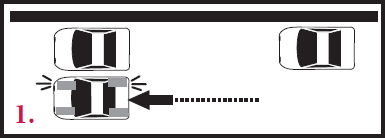
- Wait behind yous over both shoulders to make certain y'all will not interfere with pedestrians or oncoming traffic. Back the vehicle slowly and brainstorm to turn your steering wheel completely toward the most adjourn. Look through the rear window, not the mirrors, when you back up. Look to the side and front end occasionally to make sure you volition not touch on the vehicle ahead.
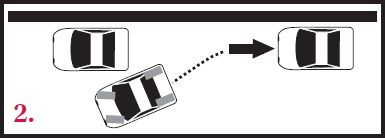
- When your forepart wheels are reverse the dorsum bumper of the vehicle ahead, turn the steering bicycle the other way while y'all go along to back up. Make certain y'all clear the vehicle alee. Look back, and stop to ensure yous exercise not bump the vehicle backside you.

- Bring your wheels straight and pull forward. Permit room for the vehicles ahead and backside yous. In your concluding parking position, your wheels must be no more than one foot (30 cm) from the curb.

To get nearer to the curb, alternately pull forward and back up, and turn the steering wheel first toward the adjourn and then quickly straight again.
After parking, remember that y'all must non open the door on the route side if it will interfere with bicyclists and other traffic.
HOW TO PARK ON A HILL
After you park on a loma, make sure to set your parking brake. Put the transmission in "Park" (or, if your vehicle has a manual transmission, put the manual into 1st gear). Turn the wheels toward the curb or side of the road, so they will keep your vehicle from heading into traffic.
HOW TO PULL OUT FROM PARALLEL PARKING
To pull away from a parallel parking space, brand sure your wheels are direct, back up to the vehicle behind you and turn your wheels abroad from the adjourn.
Half-dozen steps to enter safely into traffic:
1) Plough your head to expect over your right shoulder and check through the rear-window for pedestrians, bicyclists, motorcyclists and other vehicles that tin can become a adventure;
ii) use your interior rear-view mirror to help keep an eye on hazards behind your vehicle;
three) signal your intentions to move from your parking space into traffic;
4) cheque your side mirrors for oncoming vehicles, pedestrians, bicyclists, in-line skaters, motorcyclists and other highway users;
5) plow your caput to look over your left shoulder out through the rear-window and begin to slowly drive forrad. Make sure y'all can avoid the vehicle parked alee when you enter traffic;
six) turn your caput and look over your left shoulder to look through the rear-window, drive into the traffic lane when it is safe to do and so.
PARKING REGULATIONS
What people empathize as "parking" is legally divided into three categories: parking, standing and stopping. Parking is when a vehicle is stopped, occupied or not, other than temporarily for the purpose of loading or unloading merchandise or passengers. Standing is similar to Parking, except that it only relates to receiving or discharging passengers. Stopping is literally that, bringing the vehicle to a end (fifty-fifty temporarily).
A NO PARKING sign means you can brand a temporary end to load or discharge merchandise or passengers.
A NO Standing sign ways you can make a temporary stop to load or belch passengers. The driver cannot exit the vehicle.
A NO STOPPING sign ways yous tin stop merely to obey a traffic sign, signal or officer or to prevent conflicts with other vehicles.
Also parking, standing and stopping rules, at that place are statewide rules not always indicated past signs:
You lot cannot park, stop or stand up:
- Within 15 feet (5 chiliad) of a burn down hydrant, unless a licensed driver remains in the vehicle to movement it in an emergency.
- On the road side of a parked vehicle ("double parking").
- On a sidewalk or in a crosswalk.
- In an intersection, unless permitted by signs or parking meters.
- On railroad tracks.
- Next to or opposite road work, construction or other obstructions if your vehicle blocks traffic.
- Inside 30 feet (x m) of a pedestrian safety area, unless another distance is marked.
- On a bridge or in a tunnel.
Parking or standing is non allowed:
- In front of a driveway.
- Inside xx anxiety (6 m) of a crosswalk at an intersection.
- Within 30 feet (10 m) of a traffic light, End sign or YIELD sign.
- Within 20 feet (6 chiliad) of a fire station driveway, or within 75 feet (23 chiliad) on the contrary side of the road.
- Along a adjourn that is cutting, lowered or made for access to the sidewalk.
- Y'all cannot park your vehicle within 50 anxiety (15 m ) of a railroad crossing.
RESERVED PARKING FOR PEOPLE WITH DISABILITIES
Parking reserved for persons with disabilities is a legal requirement. These special parking spaces for motorists with disabilities ensure safe and equal access to goods and services, admission which is taken for granted past many persons. You can park in reserved spaces simply if you have a permit or vehicle plates for persons with disabilities and only when the person who received the let or vehicle plates is in the vehicle.
Information technology is illegal for whatsoever vehicle to park, stop or stand up in a space reserved for people with disabilities unless it has vehicle plates for people with disabilities issued past the DMV, a New York Country Parking Permit for People with Disabilities issued by a urban center, town county or village, or a like plate or permit issued by another state. The vehicle must exist in functioning to ship the person with disabilities described in the registration or let. This law applies to spaces reserved and provided past local ordinance on streets and highways and those held for special employ past state constabulary in shopping centers that take v or more than stores and 20 or more off-street public parking spaces.
Information technology is a misdemeanor to make a fake statement or give false information on an application for vehicle plates. If you make a imitation argument or provide false information to get a parking permit for a person with a inability, you face a fine from $250 to $1,000, plus a mandatory surcharge of $30 and possible civil penalties from $250 to $1,000. These penalties use to the applicant and to a doctor provides certification.
To apply for vehicle plates for the disabled or for a NYS Parking Let for the Disabled use the MV-664.1 Instructions and Application for a Parking Permit or License Plates for People with Severe Disabilities.

Reserved spaces must be marked with signs like the one shown above, and too can be designated with pavement markings. Exercise non park in the spaces with diagonal stripes side by side to reserved parking areas. These spaces are needed to give access to those with wheelchairs and vehicles with special equipment.
The fines for parking violations on a street are fix by municipalities. Unless a municipality sets college penalties, the fine for a shopping center violation is $50 to $75 for a kickoff offense and $75 to $150 for a second law-breaking within two years in the same municipality. A mandatory surcharge of $30 will be added to each punishment.
QUESTIONS
Before you lot go on to Affiliate 8, brand sure you can answer these questions:
- Subsequently you have parallel parked, how nearly to the curb must your vehicle be?
- May you lot open a door on the road side of your vehicle if there is no oncoming traffic?
- Earlier you lot leave a parking space, what should you do?
- What does a NO STOPPING sign mean?
- Can y'all stop to load or drib off passengers at a NO STANDING or NO PARKING sign?
- May you lot park on a crosswalk in the centre of a block?
Cease of Affiliate seven:  Affiliate 7 Quiz
< Chapter 6 | Contents | Chapter viii >
partridgepostioned.blogspot.com
Source: https://dmv.ny.gov/about-dmv/chapter-7-parallel-parking
0 Response to "A Stop Sign on a Spring to Let You Know When You Need to Stop Your Car in Yoir Garage"
Post a Comment